Mood & Sleep
Persistent low mood, anxiety, mood swings, difficulty sleeping, or changes in your daily routine.
Board-Certified Psychiatrist / Care for Adults & Older Adults
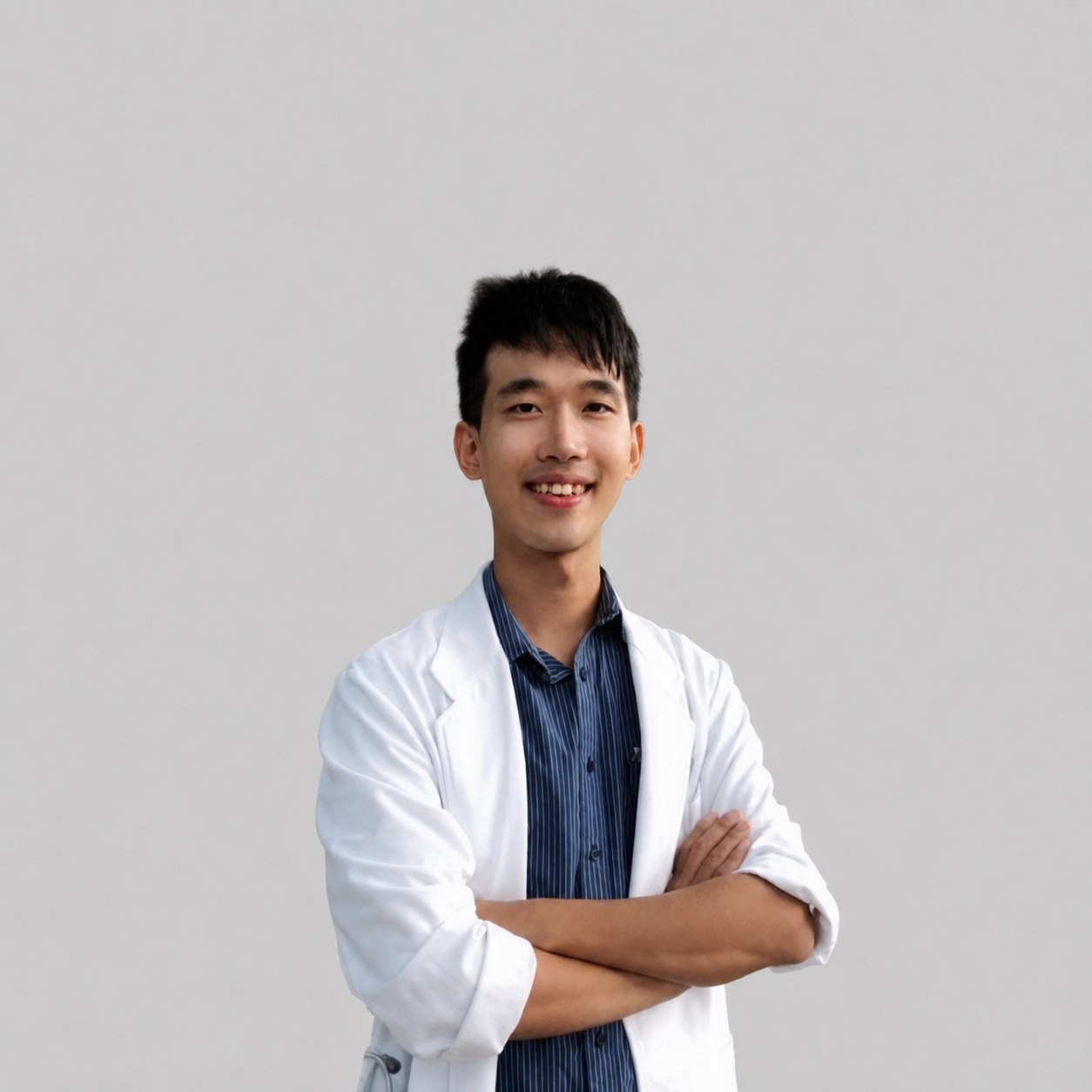
I’m Dr. Yu-Shiou Lin. If you’re experiencing anxiety, depression, insomnia, difficulty concentrating, social difficulties or memory decline, we can talk about it in clinic. Together, we’ll work to understand your symptoms and discuss treatment and care that fit your needs.
AREAS OF CARE
Starting with changes in everyday life,
we explore your symptoms and what you need.
Persistent low mood, anxiety, mood swings, difficulty sleeping, or changes in your daily routine.
Assessment and care for attention-deficit/hyperactivity disorder (ADHD) and autism spectrum disorder (ASD). We can also discuss difficulties with attention, impulsivity, social communication, and navigating relationships.
Changes in memory or cognition, emotional and behavioral concerns in older adults, and challenges faced by family caregivers.
Thoughts or experiences that are hard to describe and that affect your life, relationships, or everyday functioning.
SCREENING QUESTIONNAIRES
Choose a topic and take your time.
You can bring your results or notes to your appointment.
Established screening questionnaires with source-based questions and scoring. Results can support a clinical conversation but cannot confirm or rule out a diagnosis on their own.
Answers and results are processed only on the current page and are not sent or stored. You may print a copy; leaving or reloading clears your answers.

Reflect on mood and related symptoms over the past two weeks to support a clinical conversation.
Reflect on worry, tension, and difficulty relaxing over the past two weeks.
For adults aged 18 and over. Eighteen questions about the past six months, with separate scores for inattention and hyperactivity / impulsivity.
A 42-item measure of autistic traits, including social communication, sensory experiences and routines, to support further assessment.

A relative or friend who has known the person for at least ten years reviews changes in memory and everyday functioning, to support assessment of cognitive decline.

Fifteen yes-or-no questions about mood and everyday feelings in older adults over the past week.
Ten standard questions about drinking patterns and their effects on everyday life, to support discussion with a clinician.
If you or someone else is in immediate danger, seek emergency help now; you do not need to complete a questionnaire first.
Discuss your concerns with Dr. Lin →MEET DR. LIN
Clinical assessment, grounded
in each person's everyday life.
I graduated from the School of Medicine at National Yang-Ming University and completed five years of psychiatric training at Taipei Veterans General Hospital, including residency, chief residency, and advanced clinical training in geriatric psychiatry.
My clinical work covers adult ADHD, ASD, social and relationship difficulties, mood and sleep concerns, and mental health in older adults. During assessment, I consider symptoms, cognitive function, and the context of daily life, using this information to guide treatment planning.
I previously conducted research in psychiatry and computational neuroscience at the University of Ottawa / The Royal in Canada. The Royal(opens in a new tab) combines mental health care, research and education to improve prevention, diagnosis and treatment. Alongside clinical care, I continue to participate in international clinical trial assessment and mental health AI safety research.
Explore Research & Collaboration View professional credentials ↓ National Yang-Ming UniversitySchool of Medicine
 Taipei Veterans General HospitalPsychiatry & geriatric psychiatry training
 University of OttawaPsychiatry & computational neuroscience research
 The Royal, OttawaPsychiatry & computational neuroscience research
CREDENTIALS & TRAINING
Continuing to learn, with thoughtful care for you at the heart of my practice.

Ministry of Health and Welfare, Taiwan
Certified as a specialist in psychiatry, with professional qualifications in mental health assessment and treatment.
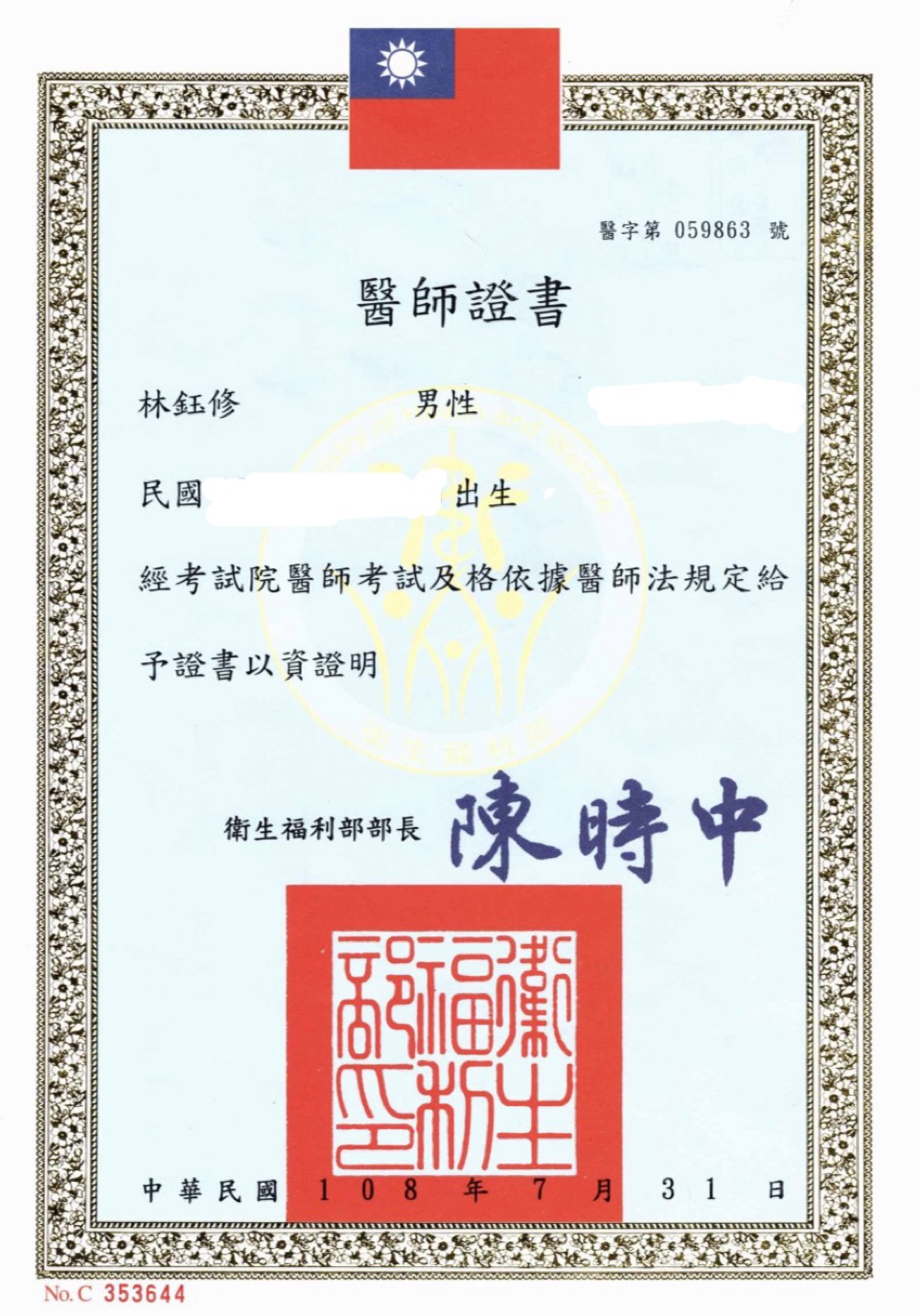
Ministry of Health and Welfare, Taiwan
Passed the national physician examination and qualified as a physician in Taiwan.

National Yang-Ming University
Completed medical education, providing a foundation for clinical practice and whole-person care.
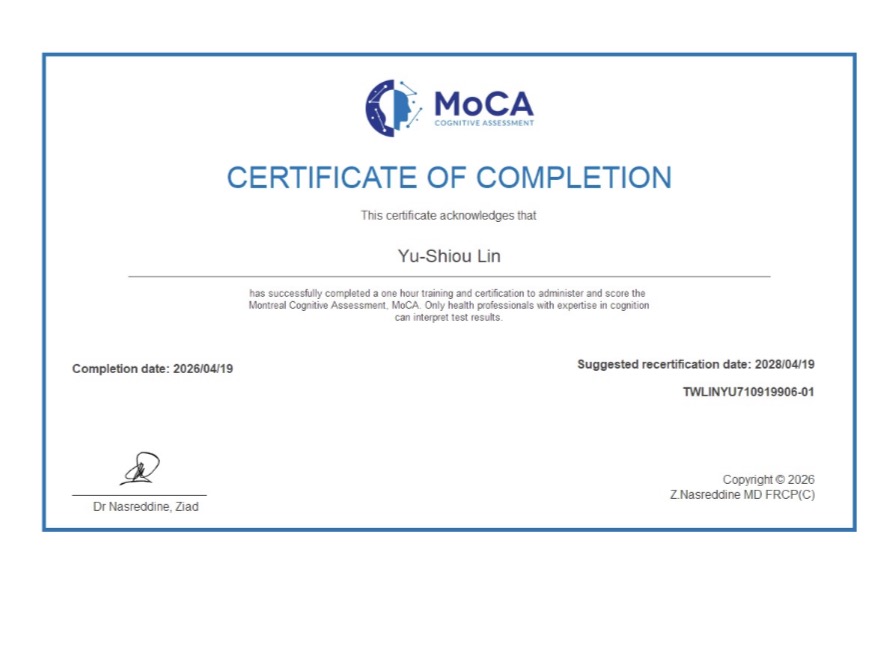
MoCA Cognition
Certified in administering and scoring the Montreal Cognitive Assessment (MoCA), a screening tool for memory, attention and other cognitive functions.
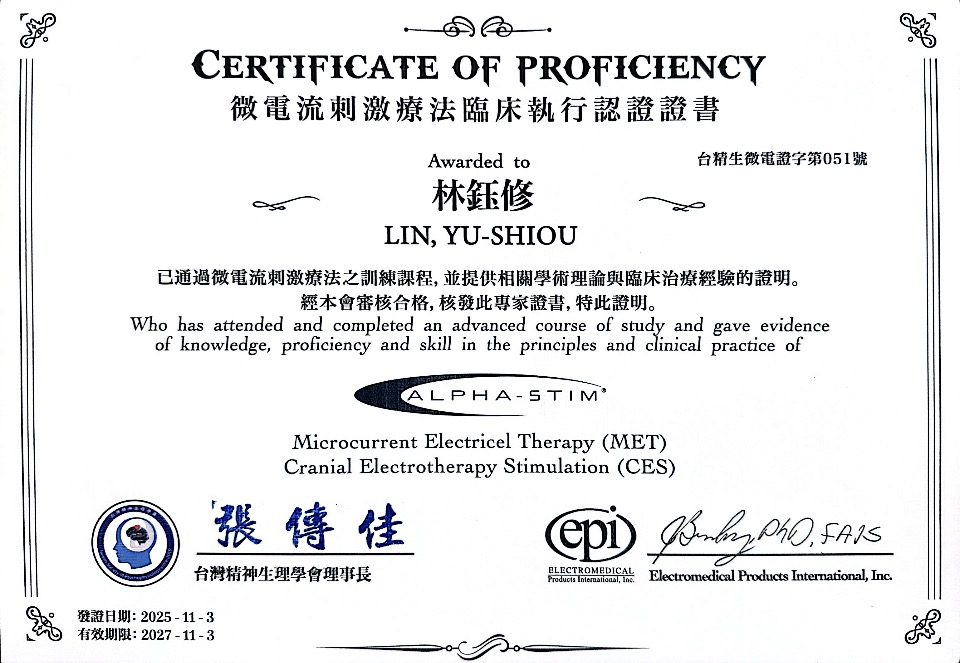
Taiwan Society of Psychophysiology & Electromedical Products International, Inc.
Completed professional training in cranial electrotherapy stimulation (CES) and microcurrent electrical therapy (MET).
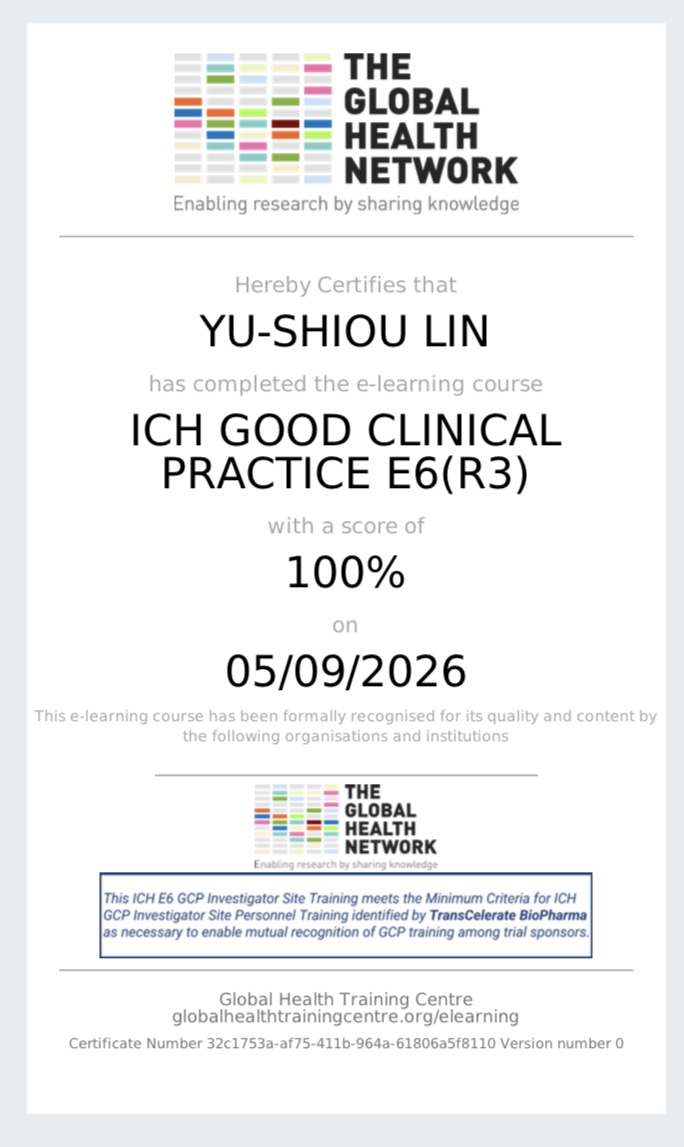
The Global Health Network · Global Health Training Centre
Completed training in international clinical research standards, covering research ethics, participant protection and study quality.
PLAN YOUR VISIT
Choose a convenient location
and book through the clinic's official channels.



Schedule updated: October 19, 2026. Clinic websites may be in Chinese. Please refer to each clinic’s latest announcements for appointment availability, closures, first-visit check-in deadlines, and fees.
BEFORE YOUR VISIT
You can prepare a few key points.
You don't need to explain everything at once.
MEDIA & TALKS
Media interview · Financial stress and mental health
In TVBS Health 2.0’s coverage of financial stress, anxiety and insomnia, Dr. Lin discussed treatment arrangements and safety considerations for cranial electrotherapy stimulation (CES). He emphasized medical assessment and an initial trial in a clinical setting before considering prescribed, physician-guided use at home.
· Kai-Syuan Psychiatric Hospital · Invited Talk
At the invitation of Kaohsiung Municipal Kai-Syuan Psychiatric Hospital, I spoke at its monthly hospital-wide AI in Medicine lecture, joining nearly forty physicians and healthcare professionals attending in person and online. Drawing on psychiatric practice and hands-on benchmarking and evaluation work with US frontier model companies, I explored AI’s potential in mental health, its limitations and the safety questions that remain. My thanks to the hospital and the program team for making this exchange possible. The recording and slides are available below to continue the conversation.
RESEARCH & COLLABORATION
Clinical Trial Assessment · Mental Health AI Safety

Central rating work supports Phase 3 psychiatric drug trials for a major international pharmaceutical company. Reviewing assessments and training clinicians helps research teams across sites evaluate symptom changes consistently and improve study data quality.
Official website (opens in a new tab)
Invited by Dr. Maurizio Fava(opens in a new tab), Chief of Psychiatry at Massachusetts General Hospital, to join MGH CTNI’s SAFER assessment program. Independent, structured interviews reassess participants’ diagnoses, symptoms and treatment histories to determine suitability for specific trials and support the quality of international psychiatric drug research.
Appointed September 2026; onboarding in progressHow SAFER works | Official overview (opens in a new tab)When people turn to AI with mental health concerns, responses need to be empathetic, safe and appropriate. Psychiatric clinical experience informs the evaluation of AI responses, helping identify potentially misleading or harmful answers and recommend improvements. Expert-designed questions also help assess the capabilities and limitations of AI in understanding problems, reasoning and making judgments.
 Mental Health Evaluation ProjectSelf-Harm & Suicide Risk · Sensitive Language · Response Safety
Conducted mental health response evaluations for OpenAI, bringing Traditional Chinese cultural and linguistic knowledge to the assessment of AI responses involving self-harm, suicide and other high-risk situations. The work involved identifying expressions of distress and potentially harmful answers, and providing clinical feedback and recommendations to help make responses safer and more appropriate.
Sole representative from Taiwan in this projectProject background · Official OpenAI article (opens in a new tab) Scale AI / Center for AI Safety
Contributions to Humanity’s Last Exam (HLE) through Outlier / Scale AI involved writing exam questions for large language models to test their specialist knowledge and reasoning. The work included computational neuroscience questions, scoring criteria and analysis of why models gave incorrect answers. At its 2025 release, HLE was among the most challenging cross-disciplinary academic AI benchmarks.
Evaluation Project Website (opens in a new tab) Related HLE benchmark paper in Nature (opens in a new tab)
This review examines recurring errors and risks when large language models assess mental health in older adults, including inconsistent diagnoses and susceptibility to misleading input. It recommends limiting near-term use to low-risk support tasks with professional oversight.
The American Journal of Geriatric Psychiatry. 2026. Published online; in press.
Journal pre-proof; volume, issue, and page numbers have not yet been assigned.
This review brings together research and expert consensus on medications for agitation in dementia, explaining potential benefits and risks. It emphasizes identifying triggers, adjusting the environment and providing support before considering medication.
Journal of the Chinese Medical Association. 2026;89(3):187–197.
This study explores how variation in the BDNF gene relates to symptom patterns and treatment resistance in people with difficult-to-treat depression, offering clues to individual differences.
Taiwanese Journal of Psychiatry. 2022;36(2):68–73.
This paper explores whether changes in drawing movements over time can help measure continuity in a person’s sense of self, with an initial demonstration in two cases. It connects neuroscience and art therapy to propose an approach for further study.
Medical Hypotheses. 2020;138:109596.
LUMEN proposes a workflow in which multiple AI agents help screen medical literature, extract data and combine findings while making computational costs visible.
arXiv. 2026; arXiv:2606.28362.
Clinical trial assessment, rater training, mental health AI evaluation, and research exchange.
For questions about visits, medication, or appointments, please contact the clinic. The collaboration email does not provide individual medical advice.